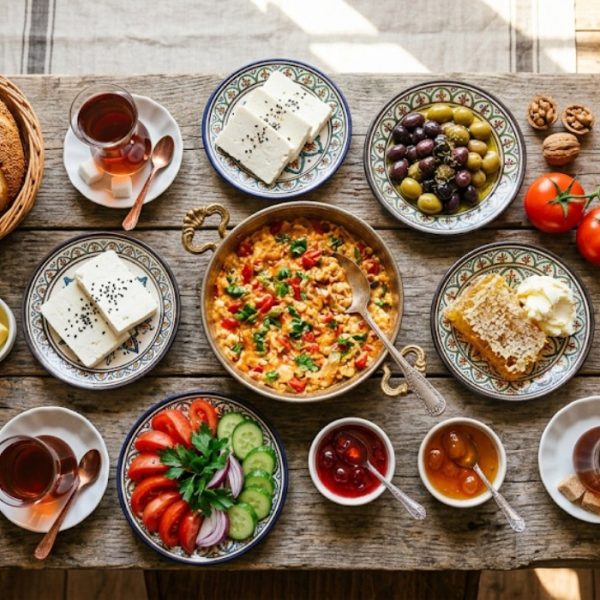
Ask someone in Istanbul what Turkish food is and you will rarely get a short answer. The country sits on the seam between the Balkans, the Caucasus, the Levant and Central Asia, and its kitchen has been collecting ideas from all of them for centuries. What came out the other end is not a fusion. It is a distinct cuisine with its own grammar, and once you learn a few of its rules the menus stop looking intimidating.
What Makes Turkish Food Its Own Thing
Three habits show up again and again. Ingredients are treated simply and seasonally, so a tomato in August is expected to taste like a tomato and is not buried under anything. Bread is present at every meal and is treated as a utensil as much as a food. And almost everything is designed to be shared, which is why a table for four often arrives covered in ten small plates rather than four large ones. Historians of Turkish cuisine trace much of this to the Ottoman palace kitchens, where regional cooking from across an enormous empire was refined and then fed back out to the provinces.
Breakfast Is the Main Event
Visitors are often surprised that the most elaborate meal of the Turkish day happens in the morning. A proper kahvaltı spread includes white cheese and aged kaşar, black and green olives, cucumber and tomato, honey with clotted cream, several jams, boiled eggs or menemen scrambled with peppers and tomato, and an endless supply of tea in small tulip-shaped glasses. It is slow food in the literal sense. Sunday breakfast in a Turkish household can run for three hours, and nobody treats that as unusual.
The Meze Table
Meze are the small cold and warm dishes that open a long evening, usually alongside rakı. Haydari is strained yoghurt with garlic and dried mint. Ezme is a fiery chopped salad of tomato, pepper and onion. Fava is a smooth puree of broad beans. Şakşuka layers fried aubergine and courgette under tomato sauce. None of these are appetisers in the Western sense, because they do not lead anywhere in particular. The point is to keep talking while eating, and the meze are engineered for exactly that.
Kebabs Are More Varied Than You Think
Outside Turkey the word kebab usually means one thing. Inside it means dozens. Adana kebab is hand-minced lamb with red pepper, hot enough to notice. Urfa kebab is the same idea without the heat. İskender arrives as sliced döner over cubes of bread, drowned in tomato sauce and browned butter, with a spoon of yoghurt on the side. Beyti is wrapped in flatbread and sliced like a roll. Each of these is associated with a specific city, and people from those cities have firm opinions about who does it properly.
Turkish Street Food After Dark
Turkish street food is where the cuisine is at its most democratic. Simit, the sesame-crusted bread ring, is sold from red carts from dawn onward. Balık ekmek is a grilled mackerel sandwich eaten standing up near the Galata Bridge. Kumpir is a baked potato mashed with butter and cheese and then loaded with whatever the customer points at. Late at night, çiğ köfte and stuffed mussels take over. The same pattern holds in most countries: the cheapest food on the pavement usually says more about a place than anything served with a tablecloth, which is the argument made rather well in this piece on what street food reveals about a culture.
Traditional Turkish Food at Home
Restaurant menus give a misleading picture, because much of the best traditional Turkish food is home cooking that rarely gets sold. Dolma, vegetables stuffed with spiced rice, takes an afternoon. Mantı, tiny dumplings under garlic yoghurt and paprika butter, is folded by hand in enormous quantities and frozen. Kuru fasulye, white beans in tomato sauce with rice on the side, is the everyday dish that most Turks would name if pushed to pick one. Soups are eaten at any hour, and mercimek, the red lentil soup with a squeeze of lemon, is close to a national reflex.
A defining table is rarely about a single dish and almost always about who is sitting around it. Anyone gathering homecoming ideas for a large family reunion learns the same thing quickly, since the menu is the easiest way to signal exactly which branch of a tradition is being honoured. Catering decisions carry a surprising amount of meaning.
National habits are held with a conviction that surprises outsiders, and food is only the most visible example. Practice hardens into identity. The debate around compulsory voting follows the same pattern, with each country treating its own arrangement as self-evidently correct.
Sweets, and the Business of Sugar
Baklava gets the attention, and the version from Gaziantep with local pistachios genuinely is better than most. But the dessert culture runs wider. Künefe is shredded pastry over melting cheese, served hot. Sütlaç is baked rice pudding with a scorched skin. Lokum, the confection the English-speaking world calls Turkish delight, is a serious industry with rosewater, pomegranate and double-roasted pistachio varieties that bear little resemblance to the supermarket blocks. Turkish coffee arrives afterwards, unfiltered and in a tiny cup, and the grounds at the bottom are not meant to be drunk.
How to Order Like You Know What You Are Doing
Order fewer main dishes than people, and more meze than feels sensible. Ask what came in fresh rather than reading the whole menu. Accept the tea that appears at the end, because refusing it reads as leaving early. And if you are travelling for the food rather than stumbling into it, the food-focused threads on the r/Turkey community are full of specific recommendations from people who live there, which beats a ranked list written from a desk.
Food is also one of the places where global brands most reliably misjudge a market, since taste and language do not travel as cleanly as logos do. PoliLingua's look at brands that stumbled when they crossed borders is a useful reminder that a menu translated word for word can lose the very thing that made the dish appealing.